

Table of Contents
ToggleIntroduction
If you have been seeing the term BIAB nails at nail salons or across beauty trends, you may be wondering exactly what it means and whether it is different from ordinary gel polish.
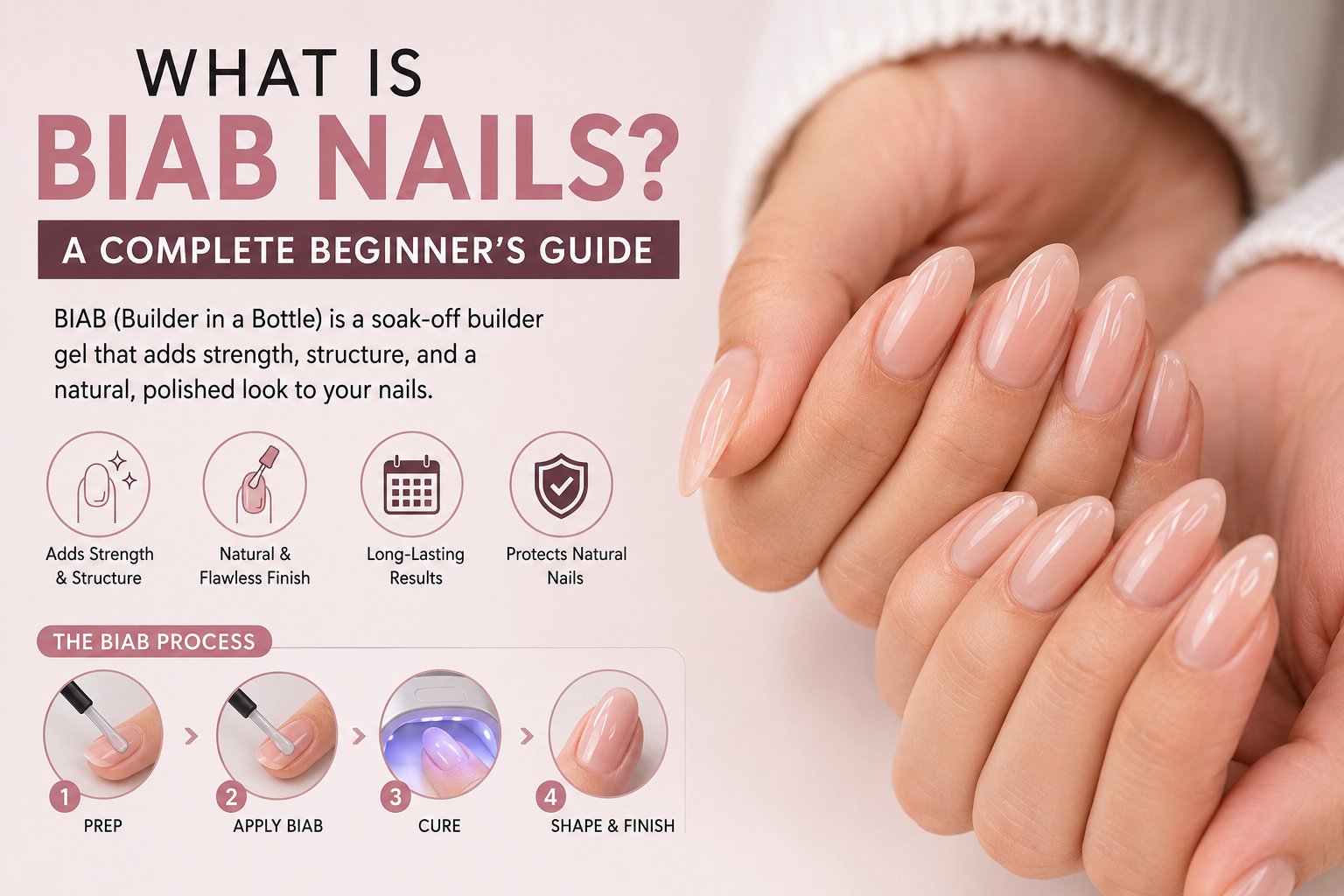
So, what is BIAB nails? BIAB stands for Builder in a Bottle, a type of soak-off builder gel designed to add structure and strength to the natural nail while also providing a polished, manicure-ready finish. Unlike traditional gel polish, which primarily adds color and shine, BIAB is formulated to create a stronger layer over the natural nail.
BIAB manicures have become popular among people who want a neat, durable manicure while maintaining the appearance of their natural nails. However, the results depend heavily on proper preparation, application, curing, and removal.
This guide explains what BIAB is, how it works, its benefits and limitations, how long it can last, and how it compares with other popular nail treatments.
Key Takeaways
- BIAB means Builder in a Bottle, a builder-gel system used to add structure to natural nails.
- It is generally applied over the natural nail and can help create a stronger, more durable manicure.
- BIAB can be used with or without color, depending on the product and desired look.
- A properly maintained BIAB manicure can typically last for several weeks before needing maintenance.
- BIAB is different from regular gel polish because its primary purpose is structure and reinforcement rather than just color.
- Proper professional application and removal are important to help avoid unnecessary nail damage.
Main Article
What Is BIAB Nails?
BIAB nails are manicures created using Builder in a Bottle, a builder-gel product designed to reinforce and add structure to the natural nail.
The product is usually packaged in a bottle similar to nail polish, making it convenient for application. Depending on the specific BIAB system, the gel may be applied directly over the natural nail and cured under an LED or UV nail lamp.
The main purpose is not simply to make nails look glossy. BIAB provides a structured layer that can make natural nails feel more supported while creating a smooth base for a manicure.
Some BIAB products are available in clear, nude, pink, and other shades, so the finished manicure can be subtle and natural-looking or used as a foundation for additional nail art.
What Does BIAB Stand For?
BIAB stands for Builder in a Bottle.
The name describes both the product’s purpose and its packaging:
- Builder: It is a builder gel intended to create structure.
- In a Bottle: The product is supplied in a bottle and can typically be applied with a brush.
The term is often used broadly when people talk about builder-gel manicures, although specific BIAB products and application systems can differ between brands.
How Does BIAB Work?
BIAB works by creating a cured gel layer over the natural nail.
The general process involves preparing the nail, applying the appropriate gel layers, and curing the product under a compatible lamp. Once cured, the material becomes a solid coating that follows the shape of the natural nail.
A typical professional application may involve:
- Cleaning and preparing the natural nail.
- Gently preparing the nail surface according to the product system.
- Applying the appropriate base or bonding layer if required.
- Applying BIAB in controlled layers.
- Building the desired structure and shape.
- Curing each layer according to the manufacturer’s instructions.
- Refining the surface if necessary.
- Adding color or nail art when desired.
- Finishing with a top coat when required.
The exact process varies by product. Following the manufacturer’s instructions is important because different builder gels can have different curing requirements and application methods.
BIAB vs. Regular Gel Polish
One of the easiest ways to understand BIAB is to compare it with regular gel polish.
| Feature | BIAB | Gel Polish |
|---|---|---|
| Main purpose | Structure and reinforcement | Color and shine |
| Adds structure | Yes | Usually minimal |
| Natural-nail overlay | Common | Common |
| Can be used with nail color | Yes | Yes |
| Cured with a lamp | Yes | Yes |
| Suitable for structured manicures | Yes | Generally not its primary purpose |
| Removal | Depends on product | Usually soak-off |
Gel polish is primarily designed to provide color and a durable finish. BIAB, by contrast, is designed to provide more structure.
This does not necessarily mean BIAB is always “better.” The right choice depends on the condition of the nails, desired appearance, lifestyle, and the specific product being used.
What Are the Benefits of BIAB Nails?
BIAB has become popular because it combines the appearance of a polished manicure with the structural qualities of builder gel.
1. It Can Add Structure to Natural Nails
One of the biggest reasons people choose BIAB is the additional structure it can provide.
For people with naturally flexible or easily splitting nails, a properly applied builder-gel overlay may provide a more supportive surface.
However, BIAB should not be considered a treatment that permanently changes the strength or health of the natural nail.
2. It Creates a Smooth, Polished Appearance
BIAB can create a smooth and even nail surface.
Nude and sheer shades are especially popular because they can produce a clean, understated manicure without requiring bold colors.
3. It Can Support Nail Growth
Because the product creates a protective overlay, some people find that their natural nails are easier to maintain while wearing BIAB.
This can be particularly useful for people who frequently experience breakage.
It is important to understand that BIAB does not make the nail grow faster. Rather, reducing everyday breakage may allow the natural nail to become longer over time.
4. It Offers Versatility
BIAB can be used as a standalone nude manicure, underneath gel color, or as a base for nail art, depending on the product system.
This makes it suitable for both minimalist manicures and more elaborate designs.
5. It Can Look Natural
When applied correctly, BIAB can be shaped relatively close to the natural nail.
A well-balanced overlay does not have to look thick or artificial. The finished appearance depends on the technician’s technique, the product, and the natural nail shape.
Are BIAB Nails Good for Your Natural Nails?
BIAB itself should not automatically be described as “good” or “bad” for natural nails.
The condition of the nail depends on several factors, including:
- Proper preparation
- Appropriate product selection
- Correct curing
- Application technique
- Maintenance
- Removal technique
- Whether the natural nail is repeatedly filed or damaged
A properly applied and maintained system can be worn over natural nails, but incorrect application or aggressive removal can contribute to nail damage.
For example, forcibly peeling or picking off cured gel can remove layers of the natural nail. Excessive filing can also thin the nail plate.
The safest approach is to have the product applied and removed according to the manufacturer’s instructions by a trained professional when possible.
How Long Do BIAB Nails Last?
A BIAB manicure can commonly remain wearable for several weeks, but longevity varies considerably.
Factors that can affect how long it lasts include:
- Natural nail growth
- Nail length
- Product quality
- Application technique
- Daily activities
- Exposure to water and chemicals
- How well the manicure is maintained
- Individual nail characteristics
As the natural nail grows, a visible gap develops near the cuticle. This is why BIAB manicures generally require maintenance rather than simply being left indefinitely.
Instead of waiting until the product has significantly lifted, regular professional maintenance can help keep the manicure balanced and reduce the temptation to pick at lifted areas.
How Often Should BIAB Nails Be Maintained?
Many people schedule maintenance roughly every 2–4 weeks, depending on how quickly their nails grow and the condition of the manicure.
Your technician may recommend a different schedule based on the specific product and your nails.
During maintenance, the technician may remove or reduce the existing product, inspect the nails, rebalance the structure, and apply fresh product.
If there is significant lifting, cracking, pain, discoloration, or another unusual change, the product should not simply be covered with another layer. The underlying nail should be assessed first.
Can BIAB Make Nails Longer?
BIAB can be used to support the appearance of longer nails, but it does not cause the natural nail to grow faster.
There are two common approaches.
Natural Nail Growth
BIAB can be applied over the natural nail. If the overlay helps reduce breakage, the natural nail may be able to grow longer without breaking as frequently.
Extensions
Some builder-gel systems can be used alongside extension techniques, depending on the specific product. However, not every BIAB product is designed for extensions.
If you want significant added length, ask the nail professional which enhancement system is appropriate rather than assuming every BIAB product can be used for extensions.
BIAB vs. Acrylic Nails
BIAB and acrylic are both enhancement systems, but they work differently.
| Feature | BIAB | Acrylic |
|---|---|---|
| Product type | Builder gel | Acrylic polymer system |
| Application | Typically gel-based | Liquid and powder |
| Curing | Requires lamp curing | Generally air cures |
| Natural-looking finish | Often very natural | Can be natural or dramatic |
| Structure | Provides structure | Provides strong structure |
| Extensions | Product-dependent | Commonly used |
| Removal | Depends on system | Typically filed and/or soaked according to system |
Acrylic may be preferred for certain extension designs or for people seeking substantial length and structure. BIAB is often chosen by people who want reinforcement of their natural nails and a more natural-looking overlay.
Neither option is universally better.
BIAB vs. Hard Gel
BIAB and hard gel are related but are not identical.
Many BIAB systems are designed to be soak-off builder gels, while traditional hard gels generally require filing for removal rather than soaking.
This distinction matters because removal procedures differ between products.
Always check the specific product’s instructions rather than assuming that every builder gel can be soaked off.
Can You Put Gel Polish Over BIAB?
Yes, depending on the product system, gel polish can often be applied over BIAB.
A common manicure might involve:
Natural nail → BIAB structure → gel color → top coat
However, compatibility matters. Products from different systems may have different requirements, so the nail technician should follow the relevant manufacturer’s instructions.
Some BIAB products are already tinted, meaning additional gel color may not be necessary.
What Does BIAB Nail Removal Involve?
Removal is an important part of maintaining healthy-looking natural nails.
The correct method depends on whether the specific BIAB product is soak-off or file-off.
A professional may carefully reduce the product and, when appropriate, use an approved removal process. The natural nail should not be aggressively scraped or peeled.
Avoid Peeling BIAB Off
One of the most important aftercare rules is simple: do not peel or pick off the product.
When gel is forcibly removed, layers of the natural nail can come away with it. This may leave the nails feeling thin, weak, or rough.
If the product begins lifting, professional removal is preferable to pulling it away yourself.
Who Might Benefit From BIAB Nails?
BIAB may be worth considering if you:
- Prefer a natural-looking manicure.
- Want additional structure over your natural nails.
- Frequently experience nail breakage.
- Like nude or minimalist nail styles.
- Want a foundation for gel color or nail art.
- Are willing to maintain the manicure regularly.
It may not be the best option for everyone. People with damaged, irritated, infected, or otherwise abnormal nails should have the underlying issue evaluated rather than simply covering it with enhancement products.
BIAB Nail Aftercare Tips
Good aftercare can help maintain both the manicure and the natural nail underneath.
Keep Nails Clean and Dry
Regular hygiene is important. Avoid leaving moisture trapped under lifted product.
Use Cuticle Oil
Applying cuticle oil regularly can help keep the surrounding skin from becoming excessively dry.
Wear Gloves for Household Chores
Frequent exposure to water and cleaning chemicals can affect both the manicure and the surrounding skin. Gloves can provide an extra layer of protection.
Don’t Use Nails as Tools
Avoid using your nails to open containers, scrape surfaces, or perform tasks that place unnecessary pressure on the nail.
Never Pick at Lifting Product
If you notice lifting, have the manicure repaired or removed appropriately instead of pulling the product away.
Are There Any Downsides to BIAB Nails?
BIAB offers several advantages, but it is not completely risk-free.
Potential drawbacks include:
- Regular maintenance is required.
- Professional applications can be more expensive than basic polish.
- Incorrect curing can cause problems with the finished product.
- Aggressive filing can damage the natural nail.
- Improper removal can cause thinning or peeling.
- Some people may experience skin irritation or allergic reactions to nail products.
If you develop persistent redness, swelling, itching, pain, or other concerning symptoms around the nails or skin, discontinue use and seek appropriate professional advice.
How Much Do BIAB Nails Cost?
The price of a BIAB manicure varies significantly by location, salon, technician, product system, nail length, and the complexity of the service.
A basic BIAB overlay will generally cost less than a service involving extensions, detailed nail art, or additional treatments.
Instead of choosing a salon based only on the lowest price, consider the technician’s qualifications, hygiene practices, product knowledge, and removal technique.
What Should You Ask Your Nail Technician?
If you are getting BIAB for the first time, asking a few questions can help you understand what you are receiving.
Consider asking:
- Which BIAB or builder-gel system do you use?
- Is the product soak-off or file-off?
- How will you prepare my natural nails?
- How often should I return for maintenance?
- How should this product be removed?
- Can this product be used with gel polish?
- What should I do if the product starts lifting?
A knowledgeable technician should be able to explain the process and aftercare clearly.
Frequently Asked Questions
What is BIAB nails?
BIAB stands for Builder in a Bottle. It is a builder-gel system used to create a structured overlay over the natural nail, helping provide additional support and a polished appearance.
Is BIAB better than gel polish?
BIAB and gel polish serve different purposes. BIAB is designed to add structure, while gel polish primarily provides color and shine. The better choice depends on your desired result.
How long do BIAB nails last?
A BIAB manicure can typically remain wearable for several weeks, although longevity depends on nail growth, application quality, lifestyle, and maintenance.
Does BIAB damage natural nails?
BIAB does not inherently mean that natural nails will be damaged. However, excessive filing, incorrect application, improper curing, or peeling the product off can contribute to nail damage.
Can BIAB help nails grow?
BIAB does not make nails grow faster. However, by adding a structured overlay, it may help reduce breakage for some people, allowing natural nails to retain more length.
Can you use BIAB on short nails?
Yes. BIAB can commonly be applied to short natural nails and can provide structure while they grow. The appropriate technique depends on the condition and shape of the nails.
Can you put regular polish over BIAB?
Depending on the BIAB system, regular nail polish may be used over the cured surface, although the finish and durability can differ from using a compatible gel-polish system.
How should BIAB be removed?
Removal depends on the specific product. Some BIAB systems are soak-off, while others require filing. The manufacturer’s instructions should always be followed, and the product should never be forcibly peeled from the natural nail.
Conclusion
So, what is BIAB nails? BIAB, or Builder in a Bottle, is a builder-gel manicure system designed to add structure and support to the natural nail while creating a smooth, polished finish.
It can be a useful option for people who want a natural-looking manicure, experience frequent breakage, or prefer a structured base for color and nail art. Its durability and appearance depend on the product used, application technique, nail condition, and proper maintenance.
The most important part of a BIAB manicure is not simply the product itself. Proper preparation, correct curing, regular maintenance, and gentle removal all play an important role in protecting the natural nail.
For beginners, the best approach is to choose a knowledgeable nail professional, understand which BIAB system they use, and follow the recommended aftercare and removal instructions.






Leave a Reply