

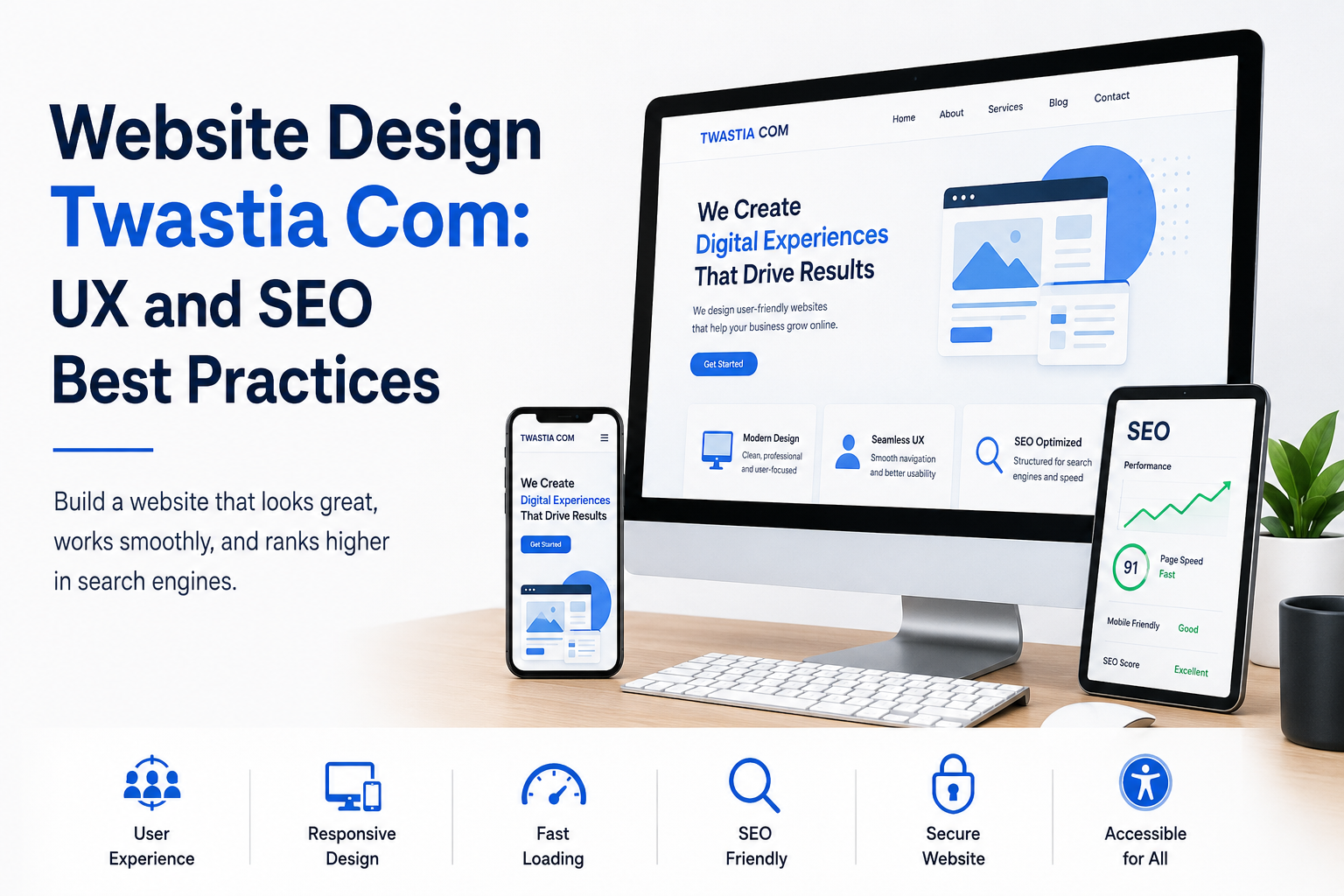
Introduction
A successful website needs to do more than look attractive. It should help visitors find information quickly, understand what a business or publication offers, and take the next step with confidence. That is where thoughtful website design, user experience (UX), and search engine optimization (SEO) work together.
The phrase website design Twastia Com can be approached as a topic covering the principles and practices that make a website useful, accessible, trustworthy, and search-friendly. Rather than focusing only on visual appearance, effective website design considers navigation, content structure, page speed, mobile usability, accessibility, calls to action, and the needs of real visitors.
Whether you are planning a new website or improving an existing one, the goal should be straightforward: create an experience that works well for people first while making the site’s content easy for search engines to understand.
This guide explains the most important website design principles, how UX affects SEO, common mistakes to avoid, and practical ways to build a better website.
Key Takeaways
- Good website design combines visual clarity, usability, accessibility, and useful content.
- Clear navigation helps visitors and search engines understand a site’s structure.
- Mobile-friendly design is essential because many users access websites from smartphones.
- SEO should be incorporated into the design process rather than added as an afterthought.
- Fast, stable pages create a better experience and can support stronger search performance.
- Trust signals, clear information, and accessible design help visitors make informed decisions.
Main Article
What Is Website Design?
Website design is the process of planning and creating the visual and functional experience of a website. It includes much more than colors, fonts, images, and layouts.
A well-designed website considers how people interact with pages from the moment they arrive. Visitors should be able to understand what the website is about, locate important information, and move between related pages without unnecessary effort.
Important components include:
- Page layout
- Navigation
- Typography
- Color and visual hierarchy
- Images and multimedia
- Mobile responsiveness
- Accessibility
- Page performance
- Calls to action
- Content organization
- Search-friendly structure
For a site associated with the topic website design Twastia Com, these principles provide a useful framework for evaluating whether a website is genuinely helpful rather than simply visually appealing.
Why UX Matters in Website Design
User experience describes how easy, efficient, and satisfying it is for visitors to interact with a website.
Imagine someone lands on an article but cannot immediately find the navigation menu, the text is difficult to read on a phone, and important links are buried beneath unrelated content. Even if the website looks modern, the overall experience is poor.
Good UX removes unnecessary friction.
A visitor should generally be able to answer three questions quickly:
- What is this website or page about?
- Where can I find the information I need?
- What should I do next?
A clear structure helps answer all three.
Visual Hierarchy
Visual hierarchy determines which elements attract attention first.
Headings, subheadings, spacing, typography, buttons, images, and content placement can guide visitors through a page. The most important information should be easy to identify without overwhelming the reader.
For example, an article page might use:
- A clear title at the top
- A short introduction
- Descriptive H2 sections
- Short paragraphs
- Supporting images
- Relevant internal links
- A useful conclusion
This structure is easier to scan than a large block of uninterrupted text.
Website Design and SEO Should Work Together
SEO and design are sometimes treated as separate disciplines, but they are closely connected.
Search optimization helps search engines understand a site’s content and relevance. Website design determines how easily users can access and interact with that content.
A search-friendly website should provide:
- Logical page hierarchy
- Descriptive headings
- Useful page titles
- Clear URLs
- Crawlable navigation
- Helpful internal links
- Mobile-friendly layouts
- Fast-loading pages
- Accessible content
- Original and relevant information
SEO should not be used as a reason to make a page difficult to read. Keyword repetition, oversized blocks of text, or excessive links can make a website less useful.
The stronger approach is to create genuinely useful pages and organize them so both people and search systems can understand them.
Create a Clear Website Structure
A logical information architecture makes a website easier to navigate.
Consider a content-focused website with categories such as:
- Technology
- Business
- Health
- Education
- Lifestyle
- Entertainment
- Sports
Each category can contain related articles and supporting pages.
This organization gives visitors predictable paths through the site. It can also help search engines understand relationships between topics.
Use Descriptive Navigation
Navigation labels should clearly describe where a link leads.
For example, labels such as:
- About
- Contact
- Technology
- Business
- Health
- Latest Articles
are generally easier to understand than vague labels such as “Explore,” “More,” or “Stuff.”
Navigation should also remain consistent across the website.
Mobile-Friendly Website Design
A website that works well on a desktop computer may still provide a poor experience on a smartphone.
Responsive design allows page layouts to adapt to different screen sizes. Text should remain readable, buttons should be easy to tap, and users should not need to zoom or scroll horizontally.
A mobile-friendly design should consider:
- Readable font sizes
- Adequate spacing between interactive elements
- Responsive images
- Flexible layouts
- Simple navigation
- Minimal intrusive elements
- Easy-to-use forms
Mobile usability is particularly important for content websites because visitors may discover individual articles through search, social platforms, or direct links rather than entering through the homepage.
Improve Website Speed and Performance
Visitors do not want to wait unnecessarily for pages to load.
Performance can be affected by large images, excessive scripts, inefficient code, unnecessary plugins, and poorly optimized third-party resources.
Practical performance improvements include:
- Compress images appropriately.
- Use modern image formats where suitable.
- Avoid unnecessary scripts.
- Reduce unused website resources.
- Use browser caching where appropriate.
- Keep page layouts stable as content loads.
- Monitor real-world performance.
Performance should be considered alongside design rather than after the visual design is complete.
A beautiful page that loads slowly can still produce a frustrating experience.
Use Strong Content Hierarchy
Content hierarchy helps readers understand the relationship between information.
A typical article might follow this structure:
H1: Main article title
Introduction: Brief explanation of the topic
H2: Primary topic
H3: Supporting concept
H2: Another primary topic
H3: Practical example
This structure creates a logical progression.
Headings should describe the content that follows them. They should not be inserted simply to create visual decoration or manipulate search rankings.
Make Website Content Easy to Read
Good design supports good writing.
Readers often scan pages before deciding whether to read them carefully. Large paragraphs can make even valuable information appear difficult.
Improve readability by:
- Keeping paragraphs relatively short
- Using descriptive headings
- Breaking complex ideas into steps
- Using bullet points when appropriate
- Explaining technical terms
- Avoiding unnecessary jargon
- Using whitespace effectively
- Highlighting important information naturally
For example, instead of explaining a complicated design process in one long paragraph, divide it into planning, structure, visual design, development, testing, and maintenance.
Build Trust Into the Website
Trust is essential for a website that wants visitors to return or take meaningful action.
A trustworthy website should make important information easy to verify and understand.
Useful trust elements can include:
- A clear About page
- Contact information
- Author information when appropriate
- Editorial policies for publishing websites
- Privacy information
- Terms and conditions where relevant
- Accurate descriptions of services
- Clear explanations of who operates the website
The exact trust signals required depend on the site’s purpose.
A publication, online store, portfolio, and business website may all need different information to establish credibility.
Accessibility Should Be Part of the Design
Accessible website design helps more people use a site effectively, including people who rely on assistive technologies.
Important practices include:
- Using meaningful headings
- Providing useful alternative text for informative images
- Maintaining sufficient text contrast
- Making navigation usable with a keyboard
- Using descriptive link text
- Avoiding unnecessary motion
- Ensuring forms have clear labels
- Providing understandable error messages
Accessibility is not simply a technical feature. It is part of creating an inclusive user experience.
Use Images Strategically
Images can make an article easier to understand, but they should serve a purpose.
A relevant image can:
- Explain a concept
- Provide visual context
- Break up long content
- Demonstrate a process
- Support a product or service explanation
Avoid adding images merely to fill empty space.
Images should also be appropriately sized and optimized so they do not unnecessarily slow down the page.
For example, an article about responsive website design could use a visual showing the same layout across desktop, tablet, and mobile screens. The image reinforces the written explanation rather than distracting from it.
Internal Linking for Better Navigation
Internal links connect related pages on the same website.
They can help visitors discover additional information and provide context about how different pages relate to each other.
For example, an article about website design could naturally link to related pages about:
- Mobile SEO
- Website accessibility
- Page performance
- Content strategy
- Search optimization
- UX research
Internal links should be relevant and useful. Adding dozens of unnecessary links can make a page harder to navigate.
Descriptive anchor text is also preferable to vague phrases such as “click here.”
Calls to Action Should Be Clear
A call to action (CTA) tells the visitor what they can do next.
Examples include:
- Read the related guide
- Contact our team
- Subscribe for updates
- View the latest articles
- Learn more about the service
A CTA should match the visitor’s likely intent.
A user reading an informational article may prefer a related educational resource rather than an aggressive sales message.
Good website design respects the user’s stage in the decision-making process.
Common Website Design Mistakes to Avoid
Even attractive websites can have usability problems.
1. Overcomplicated Navigation
Too many categories and menus can make it difficult to find important pages.
2. Poor Mobile Layouts
A layout that requires horizontal scrolling or excessive zooming can frustrate smartphone users.
3. Too Many Pop-Ups
Repeated interruptions can prevent visitors from accessing the content they came to read.
4. Weak Content Hierarchy
If every heading, button, and image demands attention, nothing feels important.
5. Slow Pages
Large media files and unnecessary scripts can negatively affect the overall experience.
6. Unclear Calls to Action
Visitors should not have to guess what action they can take next.
7. Keyword-Focused Design
Trying to insert keywords everywhere can make content and navigation sound unnatural.
8. Ignoring Accessibility
A website that works for some users but excludes others has an avoidable design problem.
A Practical Website Design Checklist
Before publishing a page, review it using a simple checklist:
| Area | Questions to Ask |
|---|---|
| Navigation | Can visitors quickly find important pages? |
| Content | Does the page answer the visitor’s main question? |
| Mobile | Is the page easy to use on smaller screens? |
| Performance | Does the page load efficiently? |
| SEO | Are titles, headings, links, and URLs descriptive? |
| Accessibility | Can different users access and understand the content? |
| Trust | Is important website information easy to find? |
| Visual Design | Is the layout clear rather than distracting? |
| CTA | Is the next useful action obvious? |
| Maintenance | Can the content and design be updated easily? |
This type of review can reveal problems that may not be obvious during the initial design process.
How to Improve Website Design Over Time
Website design should not be considered a one-time project.
Visitor expectations, technology, content requirements, and business objectives change. Regular reviews can help identify areas that need improvement.
A practical improvement process is:
- Review important website pages.
- Identify usability problems.
- Check mobile layouts.
- Examine page performance.
- Review navigation and internal linking.
- Update outdated content.
- Test important forms and buttons.
- Check accessibility issues.
- Analyze meaningful performance data.
- Prioritize improvements based on user needs.
The goal is not to redesign everything whenever trends change. Instead, make improvements that solve real problems.
What Makes a Website Design Truly Effective?
The strongest websites usually balance several factors instead of focusing on one.
A visually impressive website with confusing navigation is not effective. A fast website with poor content is not enough either. Likewise, an SEO-focused website that ignores human readers can struggle to build long-term trust.
Effective website design brings together:
Usability + Content + Performance + Accessibility + Trust + Search Visibility
When these elements work together, visitors can find information more easily and interact with the website more confidently.
Frequently Asked Questions
What does website design Twastia Com mean?
The phrase can refer to website design concepts and best practices associated with Twastia Com. In practical terms, it can be approached through UX, SEO, mobile usability, accessibility, performance, and content structure.
What is the most important part of website design?
There is no single element that matters in every situation. Clear navigation, useful content, mobile usability, accessibility, performance, and a logical page structure all contribute to an effective website.
Does website design affect SEO?
Yes. Design decisions can influence how easily users and search engines access, understand, and navigate website content. Mobile usability, page performance, information architecture, internal linking, and content structure are particularly important areas to consider.
How can I make a website more user-friendly?
Start by simplifying navigation, improving readability, making pages responsive, reducing unnecessary interruptions, clarifying calls to action, improving performance, and testing the site from a visitor’s perspective.
Why is responsive design important?
Responsive design allows a website to adapt to different screen sizes. It can make content easier to read and interactions easier to complete across smartphones, tablets, laptops, and desktop computers.
How often should website design be updated?
There is no universal schedule. A website should be reviewed regularly and updated when usability problems, accessibility issues, outdated content, performance concerns, or changing business needs require improvement.
Should SEO be considered during website design?
Yes. SEO is generally more effective when considered during planning and development. Building a logical structure, descriptive navigation, useful content, accessible pages, and strong internal linking from the beginning can reduce the need for major corrections later.
Conclusion
Website design Twastia Com can be understood through a people-first approach to creating websites that are useful, accessible, trustworthy, and easy to navigate. Strong design is not simply about choosing attractive colors or creating impressive visuals. It is about making information easier to find and interactions easier to complete.
The most effective approach combines UX and SEO without allowing either to dominate the other. Clear information architecture, responsive layouts, fast performance, accessible content, useful internal links, strong content hierarchy, and transparent trust signals all contribute to a better digital experience.
If you are improving an existing website, start with the fundamentals. Make the navigation clearer, simplify important pages, improve mobile usability, remove unnecessary distractions, optimize performance, and make sure the content genuinely answers visitors’ questions.
When design decisions are guided by real user needs, search visibility becomes part of a broader objective: building a website that people can understand, use, trust, and return to.










Leave a Reply