

Introduction
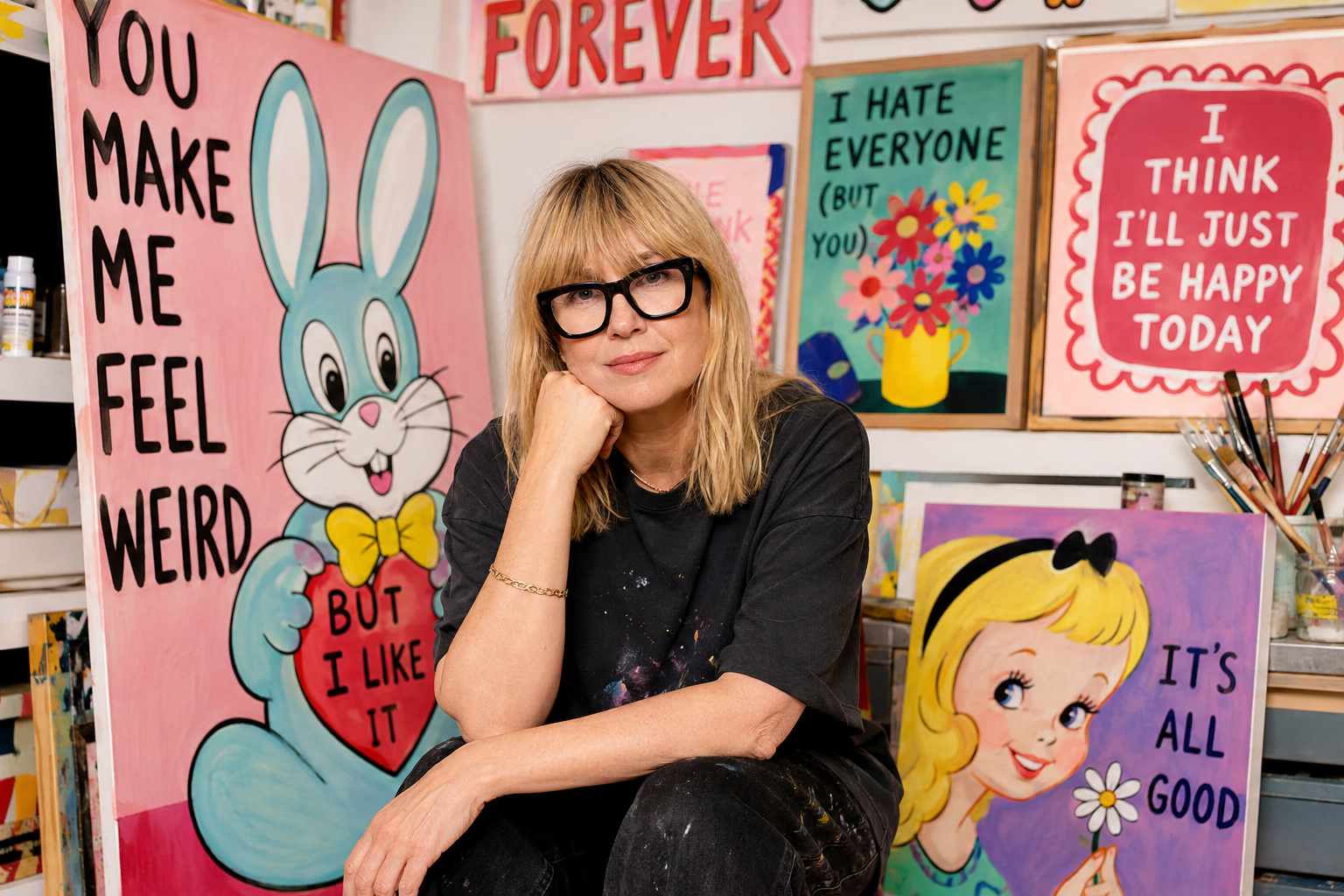
Magda Archer is a British artist whose work stands out for an unusual combination of nostalgic imagery, bright colours, humour, and sharply worded observations about modern life. Her paintings, prints, and collage-based works often place seemingly cheerful or familiar imagery beside phrases that are funny, uncomfortable, self-deprecating, or unexpectedly honest.
Born in 1964 and based in London, Archer developed her creative career across illustration, commercial projects, printmaking, painting, and contemporary art. Her background includes studies at Ravensbourne College of Art, Chelsea School of Art, and the Royal College of Art, followed by work with illustrator Peter Quinnell and a growing independent art practice.
Today, her work can be found in exhibitions, galleries, print collections, books, and collaborations with major fashion and creative brands. Her distinctive visual language has also helped make her work accessible to audiences beyond traditional contemporary-art circles.
This guide explores who Magda Archer is, how her career developed, what makes her artwork distinctive, and why her combination of nostalgia and blunt humour continues to attract attention.
Key Takeaways
- Magda Archer is a British artist born in 1964 and based in London.
- She studied at Ravensbourne College of Art, Chelsea School of Art, and the Royal College of Art.
- Her work combines nostalgic imagery, colourful compositions, text, satire, and contemporary observations.
- Archer co-founded the illustration partnership Archer/Quinnell, which achieved critical and commercial success during the late 1980s and 1990s.
- Her solo exhibition career includes Crazy Mad, which opened at The Cornerhouse in Manchester in 2011, followed by major exhibitions in the UK and elsewhere.
- She has collaborated with names including Marc Jacobs, Comme des Garçons, and Jenny Packham.
Biography of Magda Archer
| Detail | Information |
|---|---|
| Full Name | Magda Elisabeth Archer |
| Date of Birth | 1964 |
| Age | 62 in 2026 |
| Birthplace | Greenwich, London, England |
| Nationality | British |
| Profession | Artist, printmaker, illustrator |
| Education | Ravensbourne College of Art, Chelsea School of Art, Royal College of Art |
| Years Active | From the late 1980s |
| Known For | Nostalgic paintings, prints, collage, witty text, satire |
| Major Achievements | Solo exhibitions, international exhibitions, commercial collaborations, illustrated publications |
| Estimated Net Worth | Reliable public information is unavailable |
Sources identify Archer as a British artist born in 1964 and give Greenwich, London, as her birthplace. Her educational background includes Ravensbourne, Chelsea School of Art, and the Royal College of Art.
Early Life and Education
Magda Archer’s artistic development began with formal art education. She studied at Ravensbourne College of Art before continuing at Chelsea School of Art and later the Royal College of Art.
In an interview, Archer has described her time at Ravensbourne as an important stage in developing her interest in art and design. She also recalled particularly positive experiences at Chelsea School of Art and the Royal College of Art.
Her education was not simply a technical foundation. Archer has discussed how personal experimentation and learning from friends and teachers also shaped her approach. Her later work reflects that mixture of formal training and an individual, instinctive creative process.
Magda Archer’s Early Career
Before becoming widely recognised for her contemporary paintings and prints, Archer worked in illustration.
One of the most important chapters of her early career was her partnership with Peter Quinnell. Together they formed the illustration duo Archer/Quinnell in 1988. The partnership developed a strong reputation and achieved critical and commercial success during the 1990s.
Archer’s career also included work connected to publishing and popular culture. Sources record her involvement with The Beatles Anthology in 1996 and her work on the Harry Hill Fun Book.
This illustration background is important when looking at her later fine-art practice. Her artwork often retains the directness, visual economy, and storytelling qualities associated with illustration.
What Is Magda Archer Known For?
Magda Archer is particularly recognised for combining retro-inspired imagery with contemporary text.
Her work can look cheerful at first glance. Bright colours, cartoon-like characters, vintage references, flowers, animals, consumer imagery, and familiar visual motifs create an inviting surface.
Then the text changes the mood.
A sweet image might be paired with a blunt statement about relationships, anxiety, consumer culture, popularity, frustration, or everyday life. That contrast is central to Archer’s appeal.
Thames & Hudson describes her work as nostalgic paintings and collages accompanied by phrases reflecting an anxious and disillusioned temperament. Her imagery deliberately brings apparently innocent scenes into tension with more uncomfortable or ironic observations.
Nostalgia Meets Contemporary Commentary
Nostalgia is one of the strongest visual characteristics in Archer’s art.
Her work frequently draws on the appearance of older popular culture, advertising, cartoons, consumer products, and kitsch imagery. Instead of using nostalgia purely as decoration, she places it alongside contemporary language.
The result is a visual contradiction:
- Familiar imagery feels comforting.
- Bright colours create an upbeat atmosphere.
- Humorous phrases introduce tension.
- The contrast encourages viewers to reconsider the image.
- Personal experiences become broader observations about modern life.
That balance between sweetness and discomfort is one reason Archer’s work can feel both accessible and thought-provoking.
Why Is Text So Important in Magda Archer’s Art?
Text is not simply an additional decorative element in Archer’s work. It often functions as an essential part of the artwork’s meaning.
A painting without its words may appear playful or nostalgic. Once the phrase is introduced, the viewer receives another interpretation of the image.
Her approach can be understood as a form of visual juxtaposition: the image suggests one emotional direction while the words suggest another.
This creates room for humour and ambiguity.
Rather than explaining everything directly, Archer allows the relationship between image and language to produce the punchline or emotional response.
Her own comments about her practice suggest that she does not necessarily create work simply to make people happy. She has described her paintings and prints as ways of expressing particular moments, much as another person might record thoughts in a notebook.
Magda Archer’s Artistic Style
Several characteristics consistently appear in descriptions of Archer’s work.
Bold Colour
Colour plays a major role in establishing the immediate visual appeal of her pieces. Bright and saturated colours can make the artwork feel playful before the viewer reads the text.
Kitsch and Retro Imagery
Archer frequently draws on visual references associated with popular culture and nostalgia. These references give her work an instantly familiar quality.
Humour and Satire
Her phrases can be witty, sarcastic, self-deprecating, or deliberately provocative. Humour allows serious observations to be presented in an approachable way.
Emotional Honesty
Behind the jokes is often an awareness of everyday frustrations, insecurities, relationships, anxiety, and social expectations.
Image-and-Text Contrast
Perhaps the most recognisable feature is the tension between cheerful imagery and less cheerful language.
BSMT Gallery describes this balance as a combination of colourful nostalgic paintings, raw phrases, playful imagery, and a cynical outlook on life.
Magda Archer’s Major Exhibitions
Archer’s exhibition history demonstrates the development of her reputation beyond illustration and commercial design.
Her first solo exhibition, Crazy Mad, was held at The Cornerhouse in Manchester in 2011.
She subsequently exhibited widely, including participation in the Tate Liverpool exhibition Peter Blake: About Collage in 2000. Her breakthrough exhibition #givemeeverythingandnothingbaby was presented at HOME in Manchester and Chapter Arts in Cardiff in 2015.
Other notable solo exhibitions include:
- Crazy Mad — The Cornerhouse, Manchester, 2011
- Problems With Modern Life — Firstsite, Colchester, 2019
- It’s a Magda Archer Christmas — Karsten Schubert, London, 2021
- Be Popular Forever — Jealous Gallery, London, 2023
- Rare Grooves — Jealous Gallery, London, 2026
Her 2026 exhibition Rare Grooves brought together more than a decade of collaboration with Jealous and included print editions, archive material, and previously unseen original works.
Magda Archer and Fashion Collaborations
Archer’s visual language has also crossed into fashion.
Her collaborations include projects involving Marc Jacobs, Comme des Garçons, and Jenny Packham.
One particularly notable period was her collaboration with Marc Jacobs between 2019 and 2021. Jealous Gallery has highlighted works connected with that project, including My Life Is Crap and I Hate Art.
These collaborations demonstrate why Archer’s work translates effectively beyond the conventional gallery environment. Her imagery is immediately recognisable and works naturally across prints, fashion, publishing, and other commercial formats.
Magda Archer’s Books and Illustration Work
Archer’s career has not been limited to paintings and gallery prints.
Her work has appeared in publishing projects, and she has written and illustrated the children’s book Watch Out Arthur!, published by HarperCollins. She also produced What The Stars Buy, a book that explored the intersection of art and comedy.
More recently, her creative work has extended into music-related publishing. Thames & Hudson lists IDLES x Magda Archer Brutalism: Illustrated Lyrics, connecting Archer’s visual work with lyrics by IDLES frontman Joe Talbot.
This broader body of work shows the flexibility of her visual approach. Illustration, fine art, printmaking, and commercial design are not isolated parts of her career; they overlap.
How to Understand Magda Archer’s Art
For someone encountering Archer’s work for the first time, it can help to look beyond the initial joke.
A useful way to approach one of her pieces is to ask three questions:
1. What Do You Notice First?
Start with the image rather than the words. Consider the colours, characters, objects, and overall mood.
2. What Changes When You Read the Text?
The phrase may alter the emotional meaning of the image. A cute or nostalgic scene can suddenly become ironic, uncomfortable, or funny.
3. Why Might Those Two Things Be Together?
The strongest part of Archer’s work is often the relationship between the visual and verbal elements.
This approach helps explain why her work can be humorous while still addressing recognisable aspects of contemporary life.
Magda Archer’s Continuing Appeal
Part of Archer’s popularity comes from accessibility.
Contemporary art can sometimes feel difficult to approach when viewers believe they need specialist knowledge to understand it. Archer’s work often takes the opposite route. The visual language is familiar, the humour is immediate, and the text gives the viewer an obvious starting point.
But accessibility does not necessarily mean simplicity.
The contrast between image and language can create multiple interpretations. A viewer might initially laugh, then recognise a personal experience in the phrase, and finally notice a wider commentary about society or consumer culture.
That layered quality gives the work greater staying power than a simple visual joke.
Where Can You See Magda Archer’s Work?
Archer’s work has appeared through galleries, exhibitions, print studios, commercial collaborations, books, and public art projects.
Jealous Gallery has been a particularly important platform for her prints and exhibitions. The gallery has worked with Archer for more than a decade and presented exhibitions including Be Popular Forever and Rare Grooves.
Her public poster work for Flying Leaps has also contributed to her visibility in London’s urban environment.
For collectors, it is important to distinguish between original paintings, limited-edition prints, and other reproductions. Availability and pricing can vary considerably depending on the work, edition, provenance, and seller.
Frequently Asked Questions
Who is Magda Archer?
Magda Archer is a British artist and printmaker based in London. She is known for combining nostalgic imagery with colourful compositions, witty text, satire, and observations about contemporary life.
When was Magda Archer born?
Magda Archer was born in 1964. Art-biographical sources identify her as Magda Elisabeth Archer and give Greenwich, London, as her birthplace.
Where did Magda Archer study?
She studied at Ravensbourne College of Art, Chelsea School of Art, and the Royal College of Art.
What type of art does Magda Archer create?
Her practice includes paintings, prints, collage, illustration, and text-based artwork. Her signature style combines nostalgic or kitsch imagery with contemporary, humorous, and often blunt phrases.
What was Magda Archer’s first solo exhibition?
Her first solo exhibition was Crazy Mad, held at The Cornerhouse in Manchester in 2011.
Has Magda Archer worked with fashion brands?
Yes. Her collaborations have included major fashion names such as Marc Jacobs, Comme des Garçons, and Jenny Packham.
What makes Magda Archer’s artwork distinctive?
Her most recognisable characteristic is the contrast between cheerful, nostalgic imagery and witty or sometimes uncomfortable contemporary text. This creates humour while also encouraging viewers to think about the subject more deeply.
Is Magda Archer’s work available as prints?
Yes. Her work has been released through print studios and galleries, including Jealous, which has exhibited and published numerous Archer print editions. Availability varies by artwork and edition.
Conclusion
Magda Archer has built a distinctive place in contemporary British art by bringing together elements that do not initially seem to belong together: nostalgia and anxiety, sweetness and sarcasm, colourful imagery and blunt language.
Her background in illustration helped establish a strong visual vocabulary, while her later gallery practice expanded that vocabulary into paintings, prints, collage, and exhibitions. From her early work with Archer/Quinnell to solo exhibitions and collaborations with major fashion names, her career demonstrates an ability to move comfortably between commercial illustration and contemporary fine art.
Ultimately, understanding Magda Archer means looking at both halves of her work. The imagery attracts attention, but the words often provide the twist. That combination gives her art its humour, personality, and recognisable voice—and explains why her work continues to connect with audiences well beyond the traditional art world.












Leave a Reply