

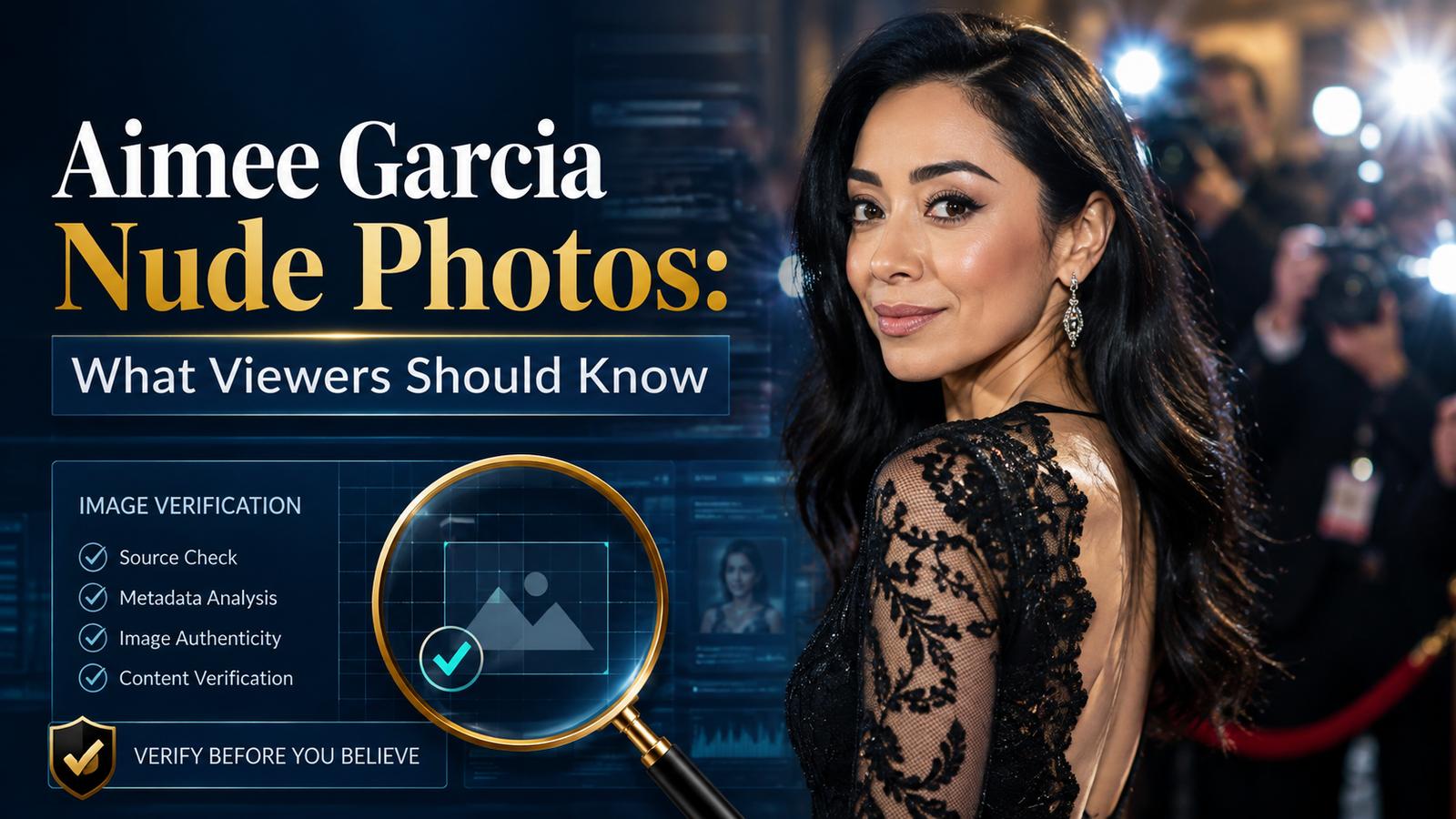
Introduction
Searches for “Aimee Garcia nude” often lead to a mixture of celebrity photographs, edited images, misleading headlines, and unverified online claims. For readers trying to determine what is genuine, the most useful approach is not to assume that every image appearing in search results is authentic.
Aimee Garcia is an American actress known for roles in television and film, including Lucifer and Dexter. Like many public figures, her name can become attached to images or claims that circulate without reliable context.
This article focuses on what viewers should know when evaluating online image claims involving Aimee Garcia. It explains how to distinguish authentic publicity or entertainment photography from manipulated or misidentified material, why search results can be misleading, and which verification methods are most useful.
Key Takeaways
- A celebrity’s name appearing beside an image does not establish that the image is authentic.
- Cropped, edited, reposted, or misidentified photographs can spread quickly online.
- Reverse-image searching and checking the earliest available source can help establish context.
- Reliable entertainment publications and official accounts are generally more useful than anonymous image-sharing pages.
- Search snippets and social-media captions should not be treated as proof.
- Readers should avoid sharing unverified intimate-image claims as factual information.
Biography Table
| Detail | Information |
|---|---|
| Full Name | Aimee Garcia |
| Date of Birth | November 28, 1978 |
| Age | 47 as of 2026 |
| Birthplace | Chicago, Illinois, United States |
| Nationality | American |
| Profession | Actress, writer, producer |
| Education | Northwestern University |
| Years Active | 1990s–present |
| Known For | Lucifer, Dexter, George Lopez, The George Lopez Show |
| Major Achievements | Established television and film career; recognized for recurring and leading roles in major productions |
| Estimated Net Worth | Not included because published celebrity estimates vary substantially and are not consistently verified |
Main Article
Who Is Aimee Garcia?
Aimee Garcia is an American actress whose career spans television, film, and voice work. She became particularly recognizable through television appearances and later gained a large international audience through her role as Ella Lopez on Lucifer.
She has also appeared in productions including Dexter, George Lopez, The George Lopez Show, and other film and television projects. Her career has included comedy, drama, voice acting, and other forms of entertainment.
Because Garcia has maintained a substantial public profile for many years, photographs associated with her can appear across entertainment websites, fan accounts, social-media platforms, and image-search results.
That broad online presence makes context particularly important when evaluating photographs attributed to her.
What Does the Search Term “Aimee Garcia Nude” Actually Tell You?
The search term itself does not establish that an authentic nude photograph exists.
Search engines organize pages according to many signals, including the words used on a webpage, links between pages, popularity, and other contextual information. As a result, a search for a celebrity’s name alongside a particular term can produce pages that repeat an allegation without providing reliable evidence for it.
This distinction is important:
A search result is not the same thing as verification.
An image may be:
- A genuine red-carpet photograph presented with a misleading caption.
- A scene from a television program or film taken out of context.
- An altered or digitally manipulated photograph.
- An image of another person incorrectly attributed to Garcia.
- A cropped photograph that removes important contextual information.
- A reposted image whose original source has disappeared.
- A fabricated claim created primarily to attract search traffic.
Readers should therefore evaluate the image and its provenance rather than relying solely on the wording surrounding it.
How to Verify a Celebrity Image
When an image appears online and its authenticity is uncertain, several practical checks can help.
Check the Original Source
Start by asking where the photograph first appeared.
A reputable entertainment publication, professional photography agency, official production archive, or verified account generally provides more useful provenance than an anonymous image-sharing website.
Look for information such as:
- Photographer or agency credit
- Original publication date
- Event or production name
- Location
- Caption information
- Associated article
- Consistent publication history
An image with no identifiable source deserves additional scrutiny.
Use Reverse-Image Search
Reverse-image search tools can sometimes reveal earlier versions of the same photograph.
This is especially useful when an image has been cropped or reposted. Comparing several results may show where the picture originally appeared and whether the current caption accurately describes it.
The earliest discoverable version is not automatically authentic, but it can provide valuable context.
Compare Facial and Background Details
Image manipulation can sometimes be detected by comparing the photograph with verified images of the same person.
Pay attention to:
- Facial proportions
- Hair and hairstyle
- Jewelry
- Tattoos or distinctive marks
- Clothing details
- Lighting direction
- Background objects
- Body positioning
- Shadows and reflections
A single visual inconsistency does not necessarily prove manipulation, but multiple inconsistencies can justify further investigation.
Why Celebrity Image Claims Spread So Quickly
Celebrity-related searches can attract substantial attention, making sensational claims particularly valuable to low-quality websites.
A misleading page may use a celebrity’s name in a headline even when the underlying image does not support the claim. Other sites may then repeat the same wording, creating the appearance of multiple independent sources.
This can produce a false sense of confirmation.
For example, imagine that five websites publish the same caption. If all five copied the information from one original unverified page, there are not actually five independent confirmations.
This is why source independence matters.
The Difference Between Authenticity and Context
Even when a photograph itself is genuine, its online description may still be inaccurate.
Consider a legitimate entertainment photograph that was originally published in connection with a film, television project, awards event, or magazine feature. A later website could crop the image and attach a completely different description.
The photograph would be real, but the claim surrounding it would be misleading.
This creates two separate questions:
- Is the photograph itself authentic?
- Is the description or claim attached to the photograph accurate?
Both questions need to be answered before treating an online image as reliable evidence.
Be Careful With Edited and AI-Generated Images
Modern image-editing technology makes it increasingly difficult to judge authenticity simply by looking at a picture.
Manipulated images can alter clothing, facial features, backgrounds, lighting, or other visual elements. A convincing appearance does not establish that an image represents a real event or photograph.
When an image makes an extraordinary claim, independent provenance becomes more important than visual realism.
Useful verification steps include:
- Find earlier versions of the image.
- Identify the original photographer or publisher when possible.
- Search for the same event or photograph in reputable archives.
- Compare the image with contemporaneous photographs.
- Look for credible reporting that independently establishes the context.
Why Anonymous Celebrity Sites Require Caution
Some websites specialize in celebrity-image searches but provide little information about where their photographs originated.
A page can appear authoritative because it contains a large gallery, professional-looking design, or extensive celebrity-related text. Those characteristics do not necessarily establish reliability.
Before accepting a claim, examine whether the website provides:
- A clear editorial identity
- Named authors or editors
- Verifiable sources
- Original reporting
- Specific photographic credits
- Correction policies
- Consistent standards across its articles
A site that simply republishes images and makes unsupported claims should not be treated as authoritative evidence.
How Social Media Can Make Verification Harder
Social platforms allow photographs to spread rapidly. Once an image becomes popular, users may repost it without knowing its origin.
Captions can also change during reposting.
A photograph might begin with an accurate description and later appear with a sensationalized caption. Eventually, the altered description may be repeated so often that users assume it must be true.
The number of shares is therefore not evidence of authenticity.
Screenshots are also problematic because they frequently remove:
- Original captions
- Dates
- Account information
- Photographer credits
- Links
- Surrounding context
Whenever possible, investigate the original post rather than relying on a screenshot.
What Readers Should Do With Unverified Intimate-Image Claims
When a celebrity image is presented as intimate or nude but its authenticity cannot be established, the safest factual approach is to describe it as unverified rather than presenting the allegation as fact.
Readers should avoid:
- Reposting questionable images as genuine.
- Adding sensational captions.
- Treating anonymous websites as authoritative sources.
- Assuming that repeated claims are independently confirmed.
- Sharing intimate-image allegations without reliable evidence.
Responsible reporting is especially important when the subject is a real person whose reputation can be affected by false or manipulated material.
A Practical Verification Checklist
If you encounter a questionable image associated with Aimee Garcia, use this quick checklist:
Source
Where did the image originate?
Date
Does the publication date match the supposed event or context?
Photographer
Is there a legitimate photographer, agency, studio, or publication credit?
Reverse Search
Do earlier versions of the image appear elsewhere?
Context
Does the surrounding description accurately explain what the photograph shows?
Independent Confirmation
Do reputable, independent sources support the same claim?
Manipulation
Are there signs that the image has been edited, composited, or otherwise altered?
If several of these questions cannot be answered, the claim should remain unverified.
Common Mistakes When Researching Celebrity Photos
One of the biggest mistakes is treating the first search result as the most reliable source.
Another is assuming that several websites repeating identical wording constitute independent confirmation.
Readers can also make the mistake of judging authenticity solely by visual quality. A high-resolution image can still be manipulated, while a low-quality photograph can still be genuine.
The better approach is to combine source verification, image comparison, publication history, and independent reporting.
Frequently Asked Questions
Is there a verified Aimee Garcia nude photo?
Search results alone do not establish the authenticity of an intimate photograph attributed to Aimee Garcia. Individual images should be evaluated through reliable provenance and independent verification.
Why do searches for Aimee Garcia nude produce many different images?
Search engines can surface pages that use the same celebrity name and search terms for traffic. Some images may be unrelated, misidentified, edited, or presented without adequate context.
How can I tell if a celebrity photograph has been manipulated?
Look for inconsistencies in lighting, edges, proportions, reflections, facial details, and backgrounds. Reverse-image searching and finding the original source can provide stronger evidence than visual inspection alone.
Does a large number of websites prove that an image is real?
No. Multiple websites may copy information or images from the same original source. Independent, reputable sources provide much stronger evidence.
Are social-media posts reliable evidence of image authenticity?
Not necessarily. Social-media posts can be reposted, cropped, edited, or given misleading captions. The original source and supporting evidence should be checked whenever possible.
What is the best way to verify a questionable celebrity image?
Start with the original source, perform a reverse-image search, check the date and photographer information, compare credible publications, and determine whether independent sources confirm the context.
Should unverified intimate images be described as authentic?
No. If reliable evidence is unavailable, the appropriate description is that the image or claim is unverified rather than presenting speculation as fact.
Conclusion
Searches for “Aimee Garcia nude” can lead readers into a confusing mixture of legitimate entertainment photography, misleading captions, reposted material, and unverified image claims. The key lesson is that an image appearing online is not automatically proof of the story attached to it.
A more reliable approach is to investigate provenance, compare sources, use reverse-image search, examine publication dates, and distinguish independent reporting from copied claims.
For anyone researching celebrity photographs, the goal should be accuracy rather than simply finding the most sensational result. When an image cannot be reliably verified, treating it as unconfirmed is more responsible than repeating an unsupported claim.
That approach helps readers make better decisions about what they see online while keeping celebrity-related information grounded in evidence and trustworthy context.


Leave a Reply