

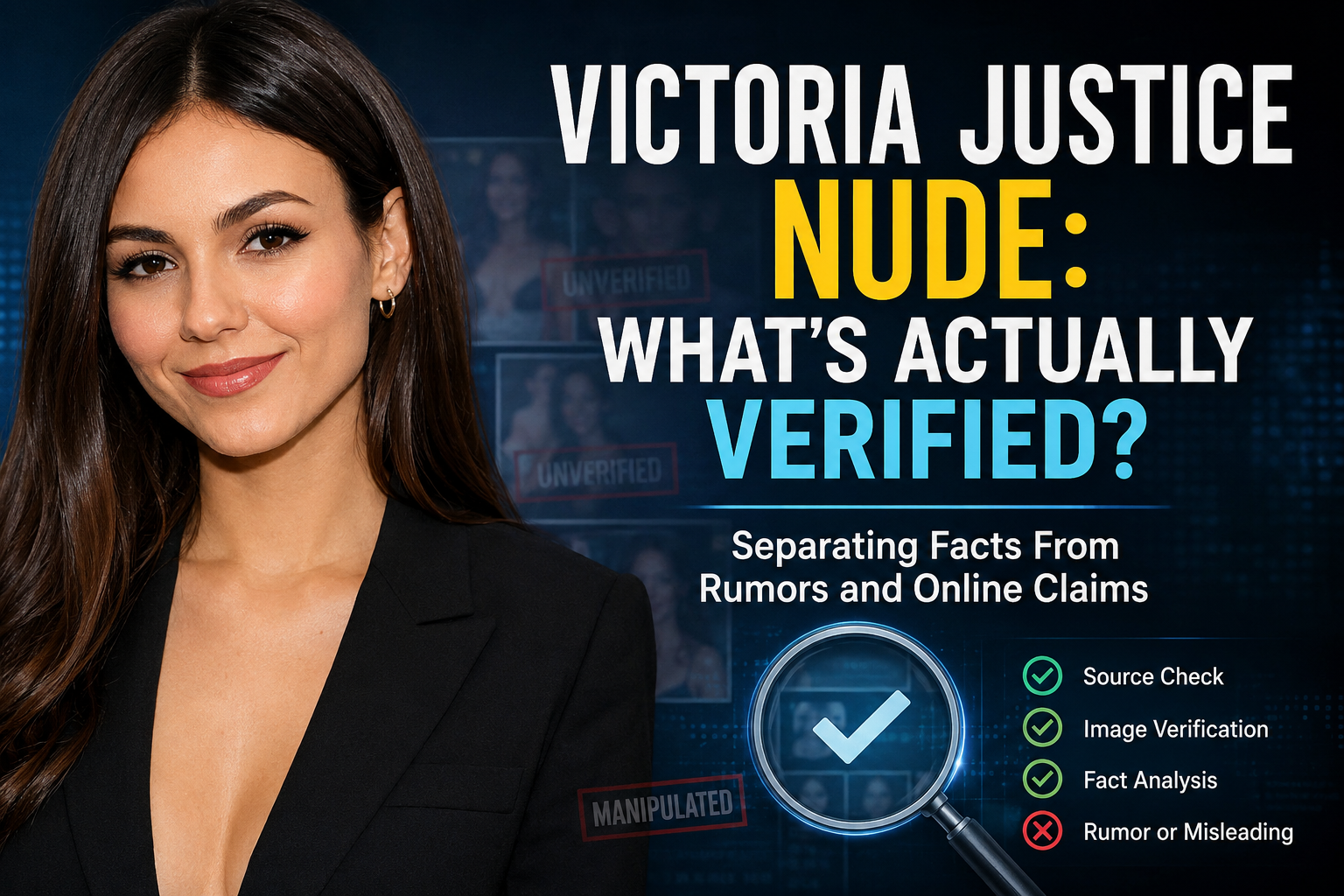
Introduction
Searches for “victoria justice nude” often lead to a mixture of celebrity photos, edited images, misleading headlines, recycled social-media posts, and unverified claims. The difficulty is that an image can look convincing while still being manipulated, mislabeled, or taken out of context.
Victoria Justice is a well-known American actress, singer, and television personality, so her name is frequently used in online content designed to attract attention. That makes it especially important to separate documented information from speculation.
This guide focuses on what can responsibly be verified, how online image claims should be evaluated, and which warning signs can help readers avoid misleading celebrity content. It does not reproduce or promote private, intimate, or allegedly leaked material.
Key Takeaways
- Victoria Justice is an American actress and singer known for television and music work.
- A search result or social-media post is not evidence that an intimate celebrity image is authentic.
- Celebrity images can be manipulated, mislabeled, cropped, or presented without their original context.
- Reverse-image searching and checking reputable sources can help establish an image’s provenance.
- Claims about private or intimate photographs should not be treated as verified without reliable evidence.
- Responsible reporting should distinguish confirmed facts from rumors and avoid redistributing potentially non-consensual material.
Biography Table
| Information | Details |
|---|---|
| Full Name | Victoria Dawn Justice |
| Date of Birth | February 19, 1993 |
| Age | 33 as of August 2026 |
| Birthplace | Hollywood, Florida, United States |
| Nationality | American |
| Profession | Actress, singer |
| Education | Attended Cleveland High School |
| Years Active | 2003–present |
| Known For | Zoey 101, Victorious, Eye Candy, music and film roles |
| Major Achievements | Major television roles and a successful career spanning acting and music |
| Estimated Net Worth | Omitted because published estimates vary and are not consistently verified |
Main Article
Why “Victoria Justice Nude” Searches Can Be Misleading
Celebrity-name searches can produce results that appear authoritative simply because they are repeated across multiple websites. Repetition, however, does not establish authenticity.
A photograph associated with Victoria Justice may be:
- A genuine public photograph presented with a misleading description.
- A digitally altered image.
- A composite created from multiple photographs.
- An image of another person incorrectly identified as her.
- An old photograph reposted under a new headline.
- A screenshot without the original source or context.
- An AI-generated or otherwise synthetic image.
- Content that has been cropped or edited to create a false impression.
For that reason, the phrase “victoria justice nude” should not automatically be interpreted as evidence that authentic private material exists.
What Does “Verified” Actually Mean?
Verification requires more than finding an image on a search engine.
A stronger verification process considers the image’s original source, publication history, context, and whether credible independent reporting supports the claim.
A useful hierarchy is:
- Primary evidence: Information originating from the person involved or an authoritative first-party source.
- Reputable reporting: Established publications that identify their sourcing and editorial standards.
- Independent corroboration: Multiple credible sources reaching the same conclusion independently.
- Original image provenance: Evidence showing where an image first appeared and how it has been distributed.
- Social-media repetition: Useful for discovering a claim, but weak as proof by itself.
- Anonymous websites: Generally insufficient for establishing authenticity.
The distinction matters because an image can circulate thousands of times without becoming authentic.
How to Check Whether a Celebrity Image Is Authentic
1. Find the Earliest Available Source
Start by asking where the image originally appeared.
A reposting website may provide no meaningful information about provenance. Look for an earlier publication with a clear date, photographer, event, publication, or other contextual information.
If every page simply copies another page, the supposed evidence may ultimately trace back to an unsupported claim.
2. Use Reverse-Image Search
Reverse-image search can reveal whether the same photograph appeared elsewhere before the current claim.
It can help identify:
- Earlier versions of an image.
- Different captions attached to the same photograph.
- Original event photography.
- Images that have been edited from an existing photograph.
- Cases where an image has been incorrectly attributed to a celebrity.
A reverse search does not automatically prove authenticity, but it can expose inconsistencies.
3. Examine the Context
Ask whether the surrounding information makes sense.
Important questions include:
- When was the image supposedly taken?
- Where was it supposedly taken?
- Was Victoria Justice publicly known to be at that location?
- Does the original photograph have a documented source?
- Do credible reports independently support the claim?
- Has the image appeared with contradictory descriptions?
Context is often more revealing than visual appearance alone.
4. Look for Signs of Manipulation
Edited images may contain inconsistencies around edges, lighting, proportions, reflections, shadows, or image quality.
However, visual inspection has limits. Modern editing technology can produce highly convincing results, so readers should not conclude that an image is authentic merely because it “looks real.”
Likewise, a few visual imperfections do not necessarily prove manipulation.
The strongest approach combines visual examination with source and provenance checks.
Why Social Media Is Not Proof
Social platforms can spread celebrity rumors extremely quickly.
One account may post a claim, dozens of accounts may repost it, and search engines may subsequently index those copies. A reader could then encounter what appears to be widespread confirmation when there is actually only one unsupported source.
This is sometimes called an echo effect: repetition creates the appearance of credibility.
When evaluating a claim, count independent sources rather than the number of times the claim appears.
Ten websites repeating the same unsourced statement are not equivalent to ten independent confirmations.
The Difference Between Public and Private Images
Another important distinction is whether a photograph was intentionally published as public content or is being presented as private material.
Public celebrity photography may include:
- Red-carpet appearances.
- Film and television events.
- Professional photoshoots.
- Magazine photography.
- Promotional campaigns.
- Public social-media posts.
An image allegedly depicting private or intimate circumstances requires a much higher level of caution. Even if someone claims that such material is genuine, redistributing it can invade privacy and amplify potentially non-consensual content.
The responsible approach is to discuss the claim and its verification status without circulating the alleged material.
Common Red Flags in Celebrity Image Claims
Several warning signs should make readers skeptical.
Sensational Headlines
Words such as “leaked,” “exclusive,” or “real” may be used to generate clicks rather than provide evidence.
A headline is a claim, not proof.
No Original Source
If an article provides no identifiable origin for an image, its authenticity is difficult to establish.
Anonymous “Insiders”
Unidentified sources can sometimes provide legitimate information, but anonymous claims without corroboration should be treated cautiously.
Watermarks From Unknown Websites
A watermark can actually make provenance harder to establish when the site simply republishes material from somewhere else.
Extremely Low-Quality Images
Poor resolution can hide manipulation and make independent identification difficult.
Conflicting Captions
If the same image is associated with different dates, locations, or circumstances, that inconsistency is a major warning sign.
What Can Actually Be Said About Victoria Justice?
Victoria Justice has had a substantial public career in television, film, and music. She became widely recognized through Nickelodeon productions, particularly Zoey 101 and Victorious, and later appeared in additional television and film projects.
Those publicly documented aspects of her career are much easier to verify than claims involving alleged private imagery.
Consequently, a responsible article about searches for victoria justice nude should avoid presenting an unverified photograph as authentic. The more accurate approach is to explain how readers can assess the claim without amplifying potentially false or invasive material.
How Responsible Celebrity Reporting Works
Good entertainment reporting separates three categories:
Confirmed: Information supported by reliable evidence.
Reported but unconfirmed: A claim attributed to a source but lacking sufficient independent verification.
Rumor or speculation: Content circulating online without reliable evidence.
This distinction is particularly important when a claim concerns a person’s privacy or reputation.
A publication should also avoid presenting search-engine results, anonymous posts, or viral social-media content as independent confirmation.
What Readers Should Do When They Encounter a Suspicious Image
If you encounter an allegedly intimate celebrity image and cannot establish its origin, the safest approach is simple:
- Do not assume it is genuine.
- Avoid downloading or redistributing it.
- Check whether reputable reporting addresses the claim.
- Use reverse-image search to investigate provenance.
- Compare the image with documented public photographs when appropriate.
- Look for inconsistencies in dates, locations, and captions.
- Treat anonymous claims as unverified unless independently corroborated.
- Report clearly deceptive or abusive content through the relevant platform.
This approach protects readers from misinformation while also respecting the privacy of the person involved.
Frequently Asked Questions
Is there a verified Victoria Justice nude photo?
A search result or viral post alone does not establish that an alleged intimate photograph is authentic. Claims should be treated as unverified unless supported by reliable, independently corroborated evidence.
How can I tell if a Victoria Justice image is fake?
Check its original source, use reverse-image search, compare publication dates and captions, and look for credible independent reporting. Visual inspection alone is not sufficient.
Are celebrity images online always authentic?
No. Celebrity photographs can be edited, mislabeled, taken out of context, or falsely attributed. Some online images may also be synthetic or composites.
Does widespread sharing prove an image is real?
No. Hundreds of accounts can repeat the same unsupported claim. Independent sourcing is much more meaningful than repetition.
What is the best way to verify an online celebrity image?
Start with provenance. Identify where the image first appeared, examine its context, perform a reverse-image search, and look for reliable independent corroboration.
Why do misleading celebrity images spread so quickly?
Celebrity names attract significant search traffic. Sensational claims can therefore generate clicks, reposts, and engagement even when the underlying material has not been verified.
Should unverified intimate images be reposted for fact-checking?
Generally, no. Fact-checking does not require redistributing potentially private or non-consensual material. Discussing the claim and explaining the verification process is usually sufficient.
What should I trust when different websites give different answers?
Prioritize identifiable sources with clear editorial standards, original documentation, and independent corroboration. Avoid treating anonymous blogs, copied articles, and social-media repetition as equivalent evidence.
Conclusion
The key lesson behind searches for victoria justice nude is that visibility is not verification. An image appearing on multiple websites, social platforms, or search results does not automatically establish that it is genuine.
A reliable assessment should focus on provenance, context, independent corroboration, and the credibility of the sources making the claim. When those elements are missing, the responsible conclusion is that the material remains unverified.
For readers, the best protection against misleading celebrity content is a careful verification process: investigate the original source, use reverse-image search, question inconsistent captions, and avoid relying on viral repetition.
Most importantly, responsible coverage should distinguish legitimate public information about Victoria Justice from unsupported claims involving her privacy. That approach provides readers with useful information without turning rumors or potentially invasive material into supposed facts.

Leave a Reply